 KR
 EN
 JP
 DE
 RU
 FR
 ES


Polystyrene Sulfonic Acid (PSSA, CAS 28210-41-5): A Functional Polymer for Electronics, Energy and Membrane Applications
With ongoing developments in renewable energy, optoelectronics, water treatment, and functional membrane technologies, the demand for high-performance water-soluble polymers continues to grow. Beyond water solubility and processability, ionic conductivity, dispersion stability, and film-forming properties have become important considerations in advanced material development.
Polystyrene Sulfonic Acid (PSSA, CAS No. 28210-41-5) is a water-soluble anionic polyelectrolyte containing strongly acidic sulfonic acid groups along its polymer backbone. Its combination of ionic functionality and polymeric characteristics makes it a versatile material for conductive polymer systems, functional coatings, ion-exchange applications, and membrane research.
창사 유텅 신소재 유한공사 is a manufacturer of Polystyrene Sulfonic Acid, with its own production facilities and R&D team. We offer customizable molecular weights, solids contents, and purity specifications to support industrial formulation development and functional material manufacturing.
1. What Is Polystyrene Sulfonic Acid (PSSA)?
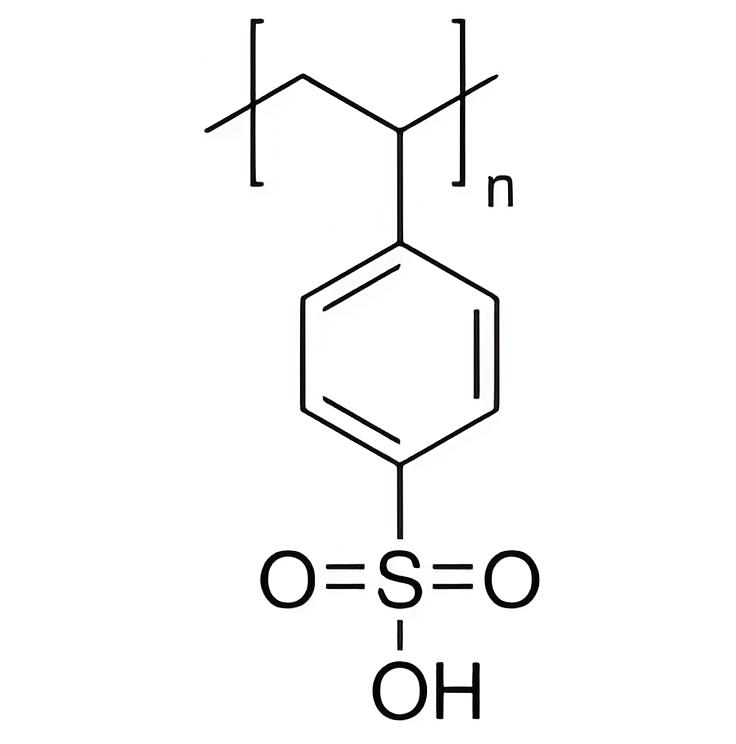
Polystyrene Sulfonic Acid (PSSA) is a functional polymer composed of styrenesulfonic acid repeating units. Its molecular chains contain numerous sulfonic acid groups (–SO₃H), making it a strongly acidic polyelectrolyte.
These functional groups provide PSSA with hydrophilic properties and ionic interaction capabilities, making it suitable for various aqueous formulations and advanced material applications.
Compared with conventional water-soluble polymers, PSSA offers not only polymer-related film-forming and rheological characteristics but also functional properties associated with proton conduction, cation exchange, and interfacial interactions.
Its key characteristics include:
- Good water solubility: Suitable for a wide range of aqueous formulations and functional material processing systems.
- Proton-conducting properties: Sulfonic acid groups provide acidic sites that can facilitate proton transport under suitable conditions.
- Cation interaction capability: The polymer can interact with certain cations in solution, providing a basis for separation and functional material development.
- Film-forming and dispersion properties: Its polymer chain structure can influence coating formation and dispersion behavior.
- Customizable specifications: Different molecular weights, solids contents, and quality parameters can be selected according to application requirements.
The actual performance of PSSA depends on molecular weight, acidity, solids content, formulation composition, and operating conditions. Application-specific material selection and testing are therefore recommended.
2. Four Key Functional Properties of Polystyrene Sulfonic Acid
2.1 Proton Conduction: Supporting Ion-Conducting Material Research
The sulfonic acid groups in PSSA provide acidic sites that can facilitate proton mobility and transport under appropriate hydration conditions.
This property makes PSSA a material of interest in proton-conducting membranes, polymer electrolytes, and related composite materials.
In fuel cell and other electrochemical material research, PSSA can be combined with other polymers or subjected to crosslinking and immobilization processes to investigate its influence on membrane ionic conductivity.
Actual proton conductivity depends on membrane hydration, temperature, structure, and formulation. The concentration of sulfonic acid groups alone does not determine final performance.
2.2 Cation Exchange: Functional Groups for Adsorption and Separation Materials
Sulfonic acid groups exhibit strong acidity and ion-exchange characteristics, allowing them to interact with cations in solution.
These properties make Polystyrene Sulfonic Acid a potential functional component in ion-exchange, adsorption, and separation materials.
For example, PSSA can be incorporated into polymer composites or immobilized within suitable material structures for research involving water treatment, metal ion separation, and functional membranes.
However, water-soluble PSSA should not be confused with insoluble ion-exchange resins. Practical water-treatment applications require additional consideration of polymer immobilization, mechanical strength, and water resistance.
2.3 Dispersion Stabilization: Improving Aqueous Formulation Performance
Particle agglomeration in coatings, slurries, and other functional dispersions can negatively affect uniformity, processing performance, and storage stability.
As an anionic polyelectrolyte, PSSA can interact with particle surfaces and other formulation components, contributing to dispersion and interfacial control.
Under suitable formulation conditions, it may help improve particle distribution and dispersion stability.
Actual performance depends on particle characteristics, pH, ionic strength, and dosage, and should be confirmed through formulation testing.
2.4 Film Formation and Membrane Modification: Adjusting Hydrophilicity and Surface Properties
PSSA combines a polymer backbone with hydrophilic sulfonic acid groups, making it relevant to functional coatings and composite membrane development.
In suitable material systems, incorporating PSSA can help modify membrane hydrophilicity, surface charge characteristics, and ion-transport behavior.
For separation membranes and proton-conducting membranes, mechanical strength, swelling behavior, water resistance, and long-term stability must also be evaluated.
Appropriate formulation design and processing techniques can further expand the potential applications of PSSA in functional membrane materials.
3. Major Applications of Polystyrene Sulfonic Acid
3.1 Optoelectronics and Electronic Materials: PEDOT Systems and Functional Coatings
Polystyrene Sulfonic Acid and its related polystyrene sulfonate materials are closely associated with conductive polymer systems based on PEDOT.
In PEDOT-based formulations, polystyrene sulfonate components commonly contribute to charge balancing, dispersion stability, and film formation, playing an important role in aqueous conductive polymer dispersions such as PEDOT:PSS.
PEDOT-based materials are widely investigated and used in transparent conductive films, organic light-emitting diodes (OLEDs), printed electronics, antistatic coatings, and functional layers in optoelectronic devices.
It is important to distinguish that PSSA itself is not a PEDOT conductive polymer, and adding PSSA alone does not necessarily improve film conductivity.
For electronic material applications, parameters such as molecular weight, acidity, impurity levels, and ionic residues should be evaluated in relation to the specific conductive polymer formulation.
3.2 Renewable Energy and Fuel Cells: Proton-Conducting and Electrolyte Materials
Proton conductivity is an important research focus in certain fuel cell technologies and polymer electrolyte systems.
Due to its high density of sulfonic acid groups, PSSA can serve as a functional component in the development of proton-conducting membranes, polymer electrolytes, and related composites.
By blending PSSA with other polymers or modifying its structure, researchers can investigate its effects on ionic conductivity, membrane hydrophilicity, and electrochemical performance.
Key evaluation parameters include proton conductivity, dimensional stability, chemical resistance, and long-term durability.
3.3 Water Treatment and Environmental Applications: Ion Exchange and Membrane Modification
Polymers containing sulfonic acid groups are relevant to research involving ion exchange, adsorption, and separation processes.
PSSA can be used as a functional raw material in the development of ion-exchange composites, separation membranes, and adsorbent materials.
With appropriate material design, its effects on membrane surface hydrophilicity, ion selectivity, and separation performance can be investigated.
For practical applications such as water softening and heavy metal removal, performance must be validated according to the immobilization method and specific water-treatment conditions.
3.4 Pharmaceutical and Biochemical Research: Functional Polymers and Related Materials
Sulfonated polymers have attracted research interest in drug carrier systems, polymer composites, and biological separation media.
PSSA can be investigated in combination with other functional materials, including studies of biomolecular interactions and polymer behavior.
In pharmaceutical applications, certain crosslinked polystyrene sulfonate resins have established uses. However, these materials differ significantly from water-soluble PSSA in their structure, physical form, and regulatory requirements.
Therefore, the use of PSSA in pharmaceutical formulations, medical devices, or other biomedical products requires dedicated safety assessments, quality evaluation, and regulatory compliance verification.
3.5 Fine Chemicals and Other Functional Materials
PSSA can also be explored in fine chemical and advanced material development, including:
- Functional water-based coatings and polymer composites
- Textile finishing and surface modification research
- Dispersion systems and rheological control
- Acidic polymer catalysis and composite catalyst research
- Polyelectrolyte compatibility studies in personal care and agricultural formulations
Different applications have different requirements for material purity, acidity, molecular weight, and residual substances. Product selection should therefore be based on the technical specifications of the intended application.
4. How to Select the Right PSSA Specifications
For customers in renewable energy, electronic materials, and specialty chemicals, PSSA specifications can directly influence formulation design and processing performance.
Molecular Weight and Molecular Weight Distribution
Different molecular weights may result in variations in solution viscosity, polymer chain interactions, and film-forming behavior. The appropriate grade should be selected according to the intended application.
Solids Content and Acidity
Solids content affects raw material concentration and formulation dosage, while acidity influences ionic characteristics and compatibility with downstream formulations.
Impurity Control
For electronic materials and high-purity functional applications, metal ions, residual monomers, and other impurities may affect product performance. Quality requirements should be established according to the target application.
Batch-to-Batch Consistency
Consistent molecular weight, solids content, and quality parameters can help reduce formulation adjustments and minimize production variability.
Selecting a suitable PSSA raw material therefore requires consideration of not only its basic properties but also product specifications, manufacturing processes, and long-term supply reliability.
5. Changsha Yuteng New Materials: A Manufacturer of Polystyrene Sulfonic Acid
창사 유텅 신소재 유한공사 specializes in the research, development, and manufacturing of functional polymers, including Polystyrene Sulfonic Acid (PSSA, CAS No. 28210-41-5).
With our own manufacturing facilities and R&D team, we provide product supply and customized solutions to customers in domestic and international markets.
In-House R&D and Customized Molecular Weight and Solids Content
Our functional polymer synthesis and process development capabilities enable us to offer PSSA products with different molecular weights, solids contents, and quality specifications according to customer requirements.
For applications in optoelectronics, renewable energy, functional membranes, and specialty chemicals, we support raw material selection, laboratory-scale sampling, and technical specification discussions.
In-House Manufacturing and Consistent Product Quality
Our production facilities enable us to manage key processes, including synthesis, concentration, filtration, and quality inspection.
By controlling critical production parameters and quality indicators, we aim to meet customer requirements for product consistency and reliable long-term supply.
Relevant technical documentation and Certificates of Analysis (COAs) are available to support material evaluation and procurement management.
Factory-Direct Supply, Bulk Orders, and Export Services
Supported by our manufacturing capabilities, Changsha Yuteng New Materials offers flexible packaging options, evaluation samples, and bulk supply arrangements.
For domestic and international customers, we coordinate product delivery, logistics, and relevant export documentation to support long-term purchasing partnerships.
Customers requiring specific purity levels, metal ion limits, or other specialized quality parameters are welcome to discuss customized specifications and technical feasibility with our team.
결론
With its sulfonic acid functional groups and polymeric backbone, Polystyrene Sulfonic Acid offers valuable properties for research and development in proton conduction, ion exchange, dispersion stabilization, and membrane modification.
As optoelectronics, renewable energy, and functional polymer technologies continue to advance, product specifications, quality consistency, and customization capabilities will remain important considerations when selecting a PSSA supplier.
Looking for a reliable Polystyrene Sulfonic Acid (PSSA, CAS No. 28210-41-5) manufacturer?
연락처 창사 유텅 신소재 유한공사 to discuss product specifications, customized grades, COA documentation, evaluation samples, and bulk purchasing options.