 EN
 JP
 DE
 KR
 RU
 FR
 ES


L-Selenomethionine in Selenium Biofortification: Applications in Selenium-Enriched Crops and Fertilizer Research
As consumers pay increasing attention to food nutrition and quality, selenium-enriched agricultural products, including rice, fruits, vegetables, and tea, are attracting growing interest.
In selenium biofortification, the objective is not simply to increase the selenium content of crops. Selecting an appropriate selenium source, controlling application rates, and maintaining consistent selenium levels and product quality are equally important.
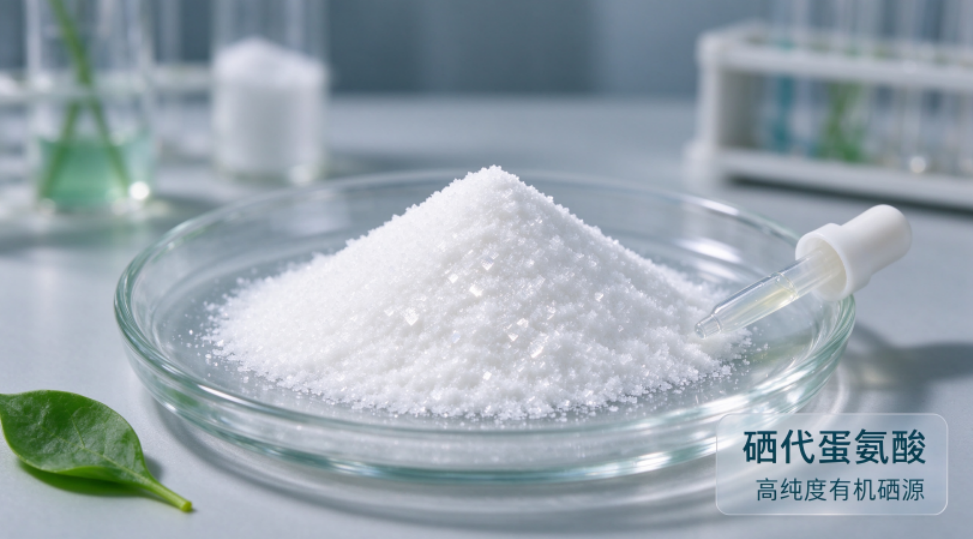
L-Selenomethionine (L-SeMet, CAS No. 3211-76-5) is a selenium-containing amino acid and an important organic selenium compound. Because its molecular structure is similar to that of methionine, it may participate in plant uptake, transport, and metabolism of organic selenium compounds, making it a potential material for selenium biofortification and agricultural research.
As a manufacturer of L-Selenomethionine, Changsha Yuteng New Materials Co., Ltd. supplies high-purity raw materials for selenium-enriched fertilizer development, agricultural formulation research, and related scientific applications.
1. Why Is Organic Selenium Attracting Attention in Agricultural Biofortification?
Selenium is an essential trace element for humans and animals, but it is not generally recognized as an essential nutrient for most higher plants.
Under suitable conditions, certain plants can absorb and accumulate selenium and convert it into different selenium-containing compounds.
Current research into agricultural selenium biofortification involves selenite, selenate, and various organic selenium compounds. Different selenium sources exhibit different uptake, transport, metabolic, and accumulation behaviors in plants.
L-Selenomethionine is an amino acid-based organic selenium compound in which selenium is incorporated into an organic molecular structure.
Due to its structural similarity to methionine, L-Selenomethionine may be absorbed by plants through relevant amino acid transport mechanisms.
However, uptake efficiency depends on crop species, application methods, environmental conditions, and selenium concentration. Organic selenium should not automatically be considered superior to inorganic selenium for every crop or growing condition.
For manufacturers developing selenium-enriched fertilizers, L-Selenomethionine represents another selenium source worth investigating when designing crop-specific biofortification strategies.
2. Potential Applications of L-Selenomethionine in Selenium-Enriched Crop Production
2.1 Selenium-Enriched Cereal Crops
Rice, wheat, and other cereal crops are important subjects of selenium biofortification research.
Through appropriate selenium management, researchers can investigate selenium uptake, transport, and accumulation in different plant tissues, providing a scientific basis for selenium-enriched grain production.
L-Selenomethionine can be evaluated as an organic selenium source in fertilizer formulation development and crop biofortification trials.
Key parameters include grain selenium concentration, the distribution of different selenium species, and the effects of application rates on plant growth and yield.
2.2 Selenium-Enriched Fruits and Vegetables
Fruit and vegetable crops vary considerably in their physiological characteristics and growing conditions.
L-Selenomethionine can be investigated to evaluate how different crops absorb and accumulate organic selenium, providing insights for the development of selenium-enriched fruit and vegetable formulations.
In addition to measuring total selenium concentrations in edible plant tissues, researchers should examine selenium speciation, plant growth responses, and food safety.
Quality characteristics such as taste, color, and shelf life should be assessed through crop-specific trials. Applying an organic selenium source does not necessarily improve these characteristics.
2.3 Selenium-Enriched Tea and Specialty Crops
Tea and other specialty crops are also important areas of selenium biofortification research.
In selenium-enriched tea development, field trials can be conducted to investigate how selenium sources, application timing, and application methods influence selenium accumulation and chemical forms in tea leaves.
L-Selenomethionine can be considered as a candidate organic selenium raw material for fertilizer formulation and agricultural application research.
Tea cultivars, soil conditions, and processing methods should all be considered when evaluating selenium accumulation and final product quality.
3. Research Applications of L-Selenomethionine in Selenium-Enriched Fertilizer Formulations
For selenium-enriched fertilizer manufacturers, the potential use of L-Selenomethionine focuses on formulation development, application methods, and experimental performance evaluation.
3.1 Foliar Fertilizer Formulation Research
Foliar application is one of the commonly studied methods in agricultural selenium biofortification.
L-Selenomethionine can be investigated as a candidate ingredient in organic selenium-containing foliar fertilizer formulations, with crop trials used to evaluate selenium uptake and accumulation.
Important formulation considerations include raw material solubility, pH, compatibility with other ingredients, and storage stability.
3.2 Water-Soluble Fertilizers and Root Application Research
In addition to foliar application, L-Selenomethionine can be studied for its suitability in water-soluble fertilizers and root-zone application systems.
Selenium availability in soil is influenced by pH, organic matter, redox conditions, and microbial activity.
Therefore, application performance should be evaluated under the specific soil and cultivation conditions of the intended crop.
3.3 Crop Stress Tolerance and Physiological Research
At appropriate concentrations, selenium may influence antioxidant metabolism and stress responses in certain plant species.
L-Selenomethionine can be used in research examining relationships between selenium nutrition, plant antioxidant systems, and responses to environmental stresses such as heat and drought.
Relevant evaluation parameters may include antioxidant enzyme activity, oxidative damage indicators, and plant growth performance.
However, selenium effects are concentration-dependent, and excessive application may cause phytotoxicity. Any potential stress-tolerance benefits must therefore be verified through crop-specific experiments.
4. Key Considerations for Selenium Biofortification in Agriculture
4.1 Selenium Concentration and Application Control
Higher selenium concentrations do not necessarily mean better selenium-enriched agricultural products.
Selenium has a relatively narrow range between nutritional adequacy and excessive intake. Agricultural production should therefore follow applicable standards in the target market and carefully control selenium concentrations in the final edible products.
4.2 Selenium Speciation Analysis
Total selenium concentration alone does not fully describe the chemical forms of selenium present in agricultural products.
For organic selenium biofortification research, suitable analytical methods may be used to determine the distribution of different selenium-containing compounds.
4.3 Crop and Soil Variability
Different crops vary in their ability to absorb and accumulate selenium.
Background soil selenium levels and cultivation conditions also influence final results.
Application strategies should therefore be developed through small-scale trials and progressively validated rather than relying on a single application rate for all crops.
4.4 Regulatory Compliance for Fertilizer Products
The availability of L-Selenomethionine as a chemical raw material does not automatically mean that it is approved for direct agricultural application or commercial fertilizer use.
Fertilizer manufacturers should verify the applicable regulations in their target markets, including permitted ingredients, product registration or notification requirements, and relevant safety assessments.
5. Changsha Yuteng New Materials: L-Selenomethionine Manufacturer and Supplier
Changsha Yuteng New Materials Co., Ltd. specializes in the research, development, and production of L-Selenomethionine (CAS No. 3211-76-5) and related products.
We supply raw materials for selenium biofortification research, fertilizer formulation development, and other organic selenium applications.
Our L-Selenomethionine product has a purity of ≥98%, with a focus on raw material quality, batch-to-batch consistency, and customer-specific requirements.
To support research institutions, fertilizer developers, and industrial customers, we offer:
- High-Purity Organic Selenium Raw Materials: L-Selenomethionine with a purity of ≥98%. Specific quality parameters are subject to the product specifications and batch-specific test results.
- Quality Documentation: Certificates of Analysis (COAs) and relevant technical documentation to support raw material selection and quality evaluation.
- Research Samples: Sample quantities for formulation screening, laboratory research, and application validation.
- Bulk Supply: Procurement options for different order volumes and long-term supply arrangements.
- Technical and Specification Support: Product information and supply solutions based on individual application requirements.
As selenium-enriched agriculture moves toward more standardized and precisely controlled production, selenium source selection, application safety, and agricultural product quality management will remain important technical considerations.
As an organic selenium research material, L-Selenomethionine offers an additional option for developing selenium-containing fertilizer formulations and investigating crop selenium biofortification.
Looking for a reliable L-Selenomethionine (CAS No. 3211-76-5) manufacturer?
Contact Changsha Yuteng New Materials Co., Ltd. to request product specifications, purity information, COA documentation, research samples, or bulk pricing.


