 RU
 EN
 JP
 DE
 KR
 FR
 ES


How to Choose High-Quality Polystyrene Sulfonic Acid (PSS): A Complete Guide to Product Quality and Supplier Selection
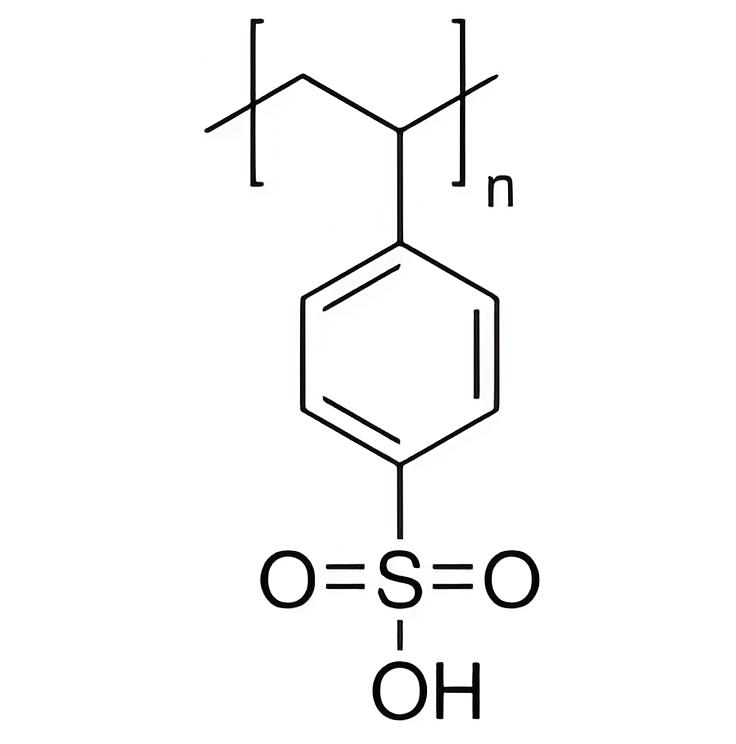
In water treatment, renewable energy, conductive polymers, and optoelectronics, Polystyrene Sulfonic Acid (PSS , CAS No. 28210-41-5) is not a raw material that should be selected solely on price or basic specifications.
Its sulfonic acid functionality, molecular weight distribution, solids content, and impurity levels can influence downstream processing performance and finished-product consistency.
For example, in proton-exchange membrane research, raw material characteristics may affect ion transport behavior. In PEDOT:PSS conductive polymer systems, PSS quality parameters can influence dispersion stability, film formation, and the resulting film properties.
Many purchasing teams have experienced similar challenges: two PSS solutions are both labeled as containing 30% solids, yet switching suppliers requires substantial formulation adjustments. PEDOT:PSS film transparency may change, dispersion stability may decline, or unexpected impurities may interfere with downstream processing.
These situations highlight an important point: selecting Polystyrene Sulfonic Acid requires more than checking the product name, nominal solids content, and purchasing price. The quality parameters that affect production consistency matter just as much.
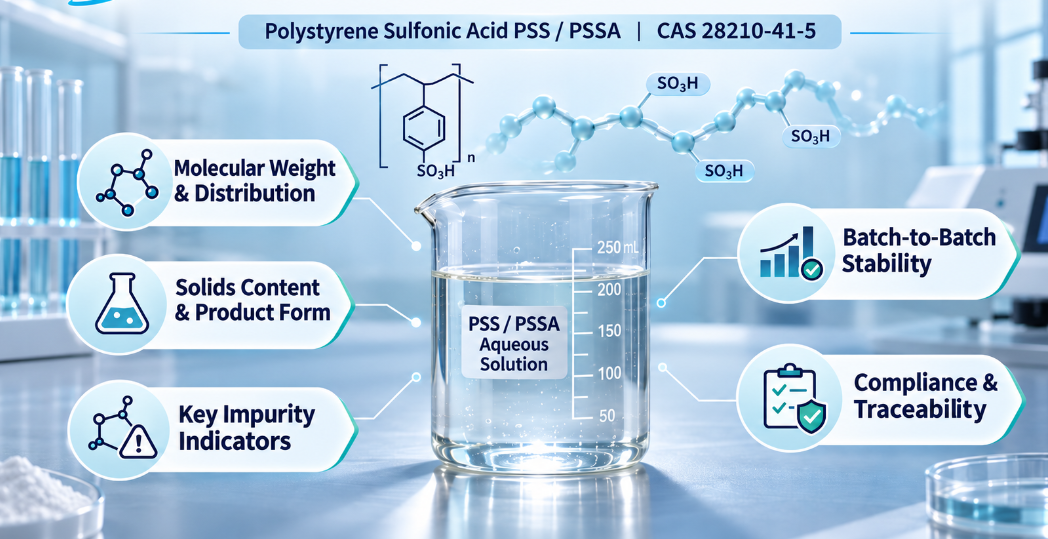
1. Five Critical Quality Parameters When Selecting Polystyrene Sulfonic Acid
1.1 Molecular Weight and Molecular Weight Distribution
Different applications may require significantly different PSS molecular weight specifications.
For certain emulsification, dispersion, and water-treatment material research applications, PSS with a molecular weight of approximately 70,000 may be evaluated depending on the formulation.
For proton-exchange membranes, OLED-related functional layers, and other precision electronic materials, molecular weight and its distribution can have a more pronounced influence on material performance.
In addition to average molecular weight, molecular weight distribution, commonly expressed as PDI or dispersity (Đ), is an important consideration.
Significant variation between batches may affect solution viscosity, dispersion behavior, film formation, and other application properties.
Even with process adjustments, it may be difficult to fully compensate for differences in raw material characteristics.
Therefore, buyers should confirm the target molecular weight range, distribution requirements, and appropriate analytical methods according to the intended application.
1.2 Solids Content and Product Form
Polystyrene Sulfonic Acid is available in different aqueous solution concentrations and solid forms, including products with nominal solids contents such as 18% and 30%, as well as high-solids grades.
Actual availability depends on the supplier and product specification.
For manufacturers using aqueous PSS solutions, solids content directly affects formulation calculations, material dosing, and process consistency.
In PEDOT:PSS-related systems, variations in PSS solids content and other quality parameters may influence polymerization, dispersion, and film formation, potentially affecting sheet resistance and optical transparency.
If the actual solids content differs significantly from the nominal value, customers may need to repeatedly adjust formulation concentrations.
For a nominal 30% solids product, customers may specify an acceptable tolerance, such as ±1 percentage point, according to their process requirements. This should be treated as a purchasing specification rather than a universal standard for all PSS products.
Buyers should verify actual solids content, permitted tolerances, and batch-specific analytical results to support reproducible formulation processes.
1.3 Critical Impurities: Residual Monomers and Metal Ions
Residual monomers, metal ions, and other impurities in PSS can affect performance in demanding applications.
For example:
- Optoelectronic Materials: Metal ions and residual monomers may influence film and device performance.
- Renewable Energy Materials: Impurities may affect electrochemical behavior, membrane stability, and related processing.
- Biomedical and IVD Research: Raw material purity, relevant impurities, and application-specific quality requirements should be evaluated.
- High-Purity Functional Materials: Iron, calcium, magnesium, and other metal ions may require ppm-level or more stringent control.
It is important to distinguish water-soluble PSS from crosslinked polystyrene sulfonate ion-exchange resins. Conventional aqueous PSS should not be treated as a direct replacement for insoluble resins used in water softening or ultrapure water systems.
Applications involving ion exchange, adsorption, or separation require evaluation of the specific material structure and processing method.
Buyers should define impurity types, acceptance limits, and analytical methods based on their intended applications rather than relying on purity alone.
1.4 Batch-to-Batch Consistency
Some manufacturers encounter a common problem: initial samples meet all requirements, but subsequent bulk deliveries show noticeable performance differences.
Such variations may result from polymerization conditions, raw material quality, reaction temperature, feed ratios, and manufacturing process control.
For PSS, changes in molecular weight, molecular weight distribution, solids content, acidity, and impurity levels may affect downstream formulation behavior.
If production parameters must be readjusted for every batch, manufacturing costs and delivery schedules can be negatively affected.
Stable polymerization processes, standardized quality management, and traceable batch records are therefore important indicators of a reliable PSS supplier.
1.5 Regulatory Documentation and Traceability
For biomedical research, electronic materials, and export-related purchasing, complete technical documentation is another important consideration.
Relevant documents include:
- Certificate of Analysis (COA): Batch-specific analytical results.
- Safety Data Sheet (SDS/MSDS): Chemical safety and handling information.
- Technical Data Sheet (TDS): Product specifications and technical information.
- Relevant Compliance Documentation: Materials required for the intended application and target market.
- Batch Traceability Records: Supporting quality investigations and supplier audits.
Complete documentation and traceability help customers conduct incoming material inspections, quality reviews, and investigations when unexpected issues arise.
2. Five Factors to Evaluate When Choosing a PSS Supplier
Beyond product specifications, a supplier’s manufacturing capabilities, application experience, and delivery performance can significantly affect long-term procurement reliability.
2.1 In-House Manufacturing Capabilities
Compared with suppliers that only trade finished products, manufacturers with in-house production capabilities can more directly manage polymerization, purification, and quality testing.
For customers requiring specialized grades, a direct manufacturer may also be better positioned to evaluate customized molecular weights, solids contents, metal ion limits, and other technical parameters.
Key factors to assess include:
- In-house manufacturing and process development capabilities
- Established quality management systems, such as ISO 9001
- Appropriate analytical testing capabilities
- Availability of batch-specific COAs and technical documentation
- Support for customized specifications and technical communication
Analytical techniques such as HPLC and GC may be used for applicable impurities and related testing. Molecular weight and distribution require suitable analytical methods specific to those parameters.
For companies purchasing PSS on a recurring basis, a supplier with direct manufacturing and quality control capabilities can support more effective technical communication and specification management.
2.2 Application Experience and Technical Support
A reliable PSS supplier should understand the different performance requirements of downstream industries.
Renewable Energy and Fuel Cell Materials
Molecular weight, acidity, ion-transport behavior, and material compatibility are important considerations when selecting PSS for proton-conducting membranes and related composite research.
Water Treatment and Functional Dispersion Systems
Appropriate molecular weight, solids content, and other technical parameters should be evaluated according to the intended dispersion, flocculation, or composite material application.
Optoelectronics and Conductive Polymers
Low metal ion impurities, molecular weight distribution, solids content, and batch consistency are relevant to PEDOT:PSS systems and other electronic material applications.
Because different applications require different PSS properties, suppliers that can provide application-oriented product selection and specification support may help reduce formulation trials and material qualification costs.
2.3 Reliable Supply Chain and Delivery Capabilities
Chemical raw material procurement involves more than product quality. Manufacturing capacity, inventory planning, and logistics coordination are also essential.
Delayed raw material deliveries can disrupt downstream production schedules.
Customers should therefore evaluate suppliers with reliable production capabilities, appropriate inventory arrangements, and consistent delivery performance.
For conventional liquid products, packaging options such as 25 kg drums may be available depending on the product specification and customer requirements.
Suitable packaging and transportation measures should be used to reduce the risk of leakage or damage.
Reliable production, inventory management, and logistics coordination are important foundations for long-term supply partnerships.
2.4 Comprehensive Quality Traceability
An effective quality traceability system should cover raw material procurement, manufacturing processes, finished-product testing, and delivery.
When unexpected product performance occurs, suppliers should be able to review batch records, analytical results, and manufacturing information to assist with investigations.
For customers in biomedical research, renewable energy materials, and export markets, COAs, SDSs, and other technical documents also support supplier qualification and quality management.
However, regulatory requirements vary between applications. Standard industrial-grade documentation does not automatically replace specialized certifications required for pharmaceutical or electronic-grade materials.
2.5 Flexible Customization Capabilities
PSS requirements vary significantly between customers and applications.
Some customers need specific molecular weight ranges, while others focus on solids content, pH, viscosity, metal ion limits, or residual impurities.
A supplier’s ability to evaluate and provide customized specifications can therefore influence material compatibility and processing efficiency.
Manufacturers with R&D and production capabilities can discuss application requirements, assess technical feasibility, and adjust relevant specifications to better support existing production processes.
3. YUTENG New Materials: Consistent and Customizable Polystyrene Sulfonic Acid Supply
YUTENG New Materials specializes in the research, development, and manufacturing of functional polymer materials, including Polystyrene Sulfonic Acid (PSS/PSSA, CAS No. 28210-41-5).
With in-house manufacturing and process development capabilities, we can discuss PSS grades with different molecular weights, solids contents, and other relevant quality parameters according to customer requirements.
Our services include:
- Direct Manufacturing: In-house production and process management to control critical quality parameters.
- Customized Specifications: Technical evaluation of molecular weight, solids content, and other application-specific requirements.
- Quality Management: An emphasis on batch consistency, product testing, and traceability.
- Technical Documentation: Relevant COA, TDS, and SDS documentation.
- Flexible Procurement: Evaluation samples, flexible order quantities, and bulk supply arrangements.
- Application Support: Product selection and technical specification discussions.
For customers in conductive polymers, optoelectronics, renewable energy, and functional materials, YUTENG New Materials provides raw material selection and purchasing support based on specific application requirements.
Заключение
Polystyrene Sulfonic Acid (CAS No. 28210-41-5) may appear to be a conventional water-soluble polymer, but its molecular weight, solids content, impurity profile, and batch consistency can significantly influence performance in advanced manufacturing and functional material applications.
Purchasing PSS should involve more than comparing prices and nominal specifications. Buyers should evaluate whether the raw material can consistently meet production requirements and whether the supplier has dependable manufacturing, quality management, and technical support capabilities.
Choosing the right PSS grade and a supplier that understands your application can help reduce repeated process adjustments, minimize production variability, and improve manufacturing efficiency.
Looking for a reliable Polystyrene Sulfonic Acid manufacturer or customized PSS grades?
Contact YUTENG New Materials to discuss molecular weight options, solids content, product specifications, COAs, evaluation samples, and bulk purchasing arrangements.