 RU
 EN
 JP
 DE
 KR
 FR
 ES


Poly(4-styrenesulfonic Acid) Ammonium Salt Solution: A Functional Polymer for Antistatic Coatings, Dispersion, and Film Applications
In specialty paper, functional coatings, electronic materials, and industrial water-based formulations, raw materials must deliver more than reliable processing performance. Antistatic properties, dispersion stability, film formation, and rheological control are also important considerations in formulation development.
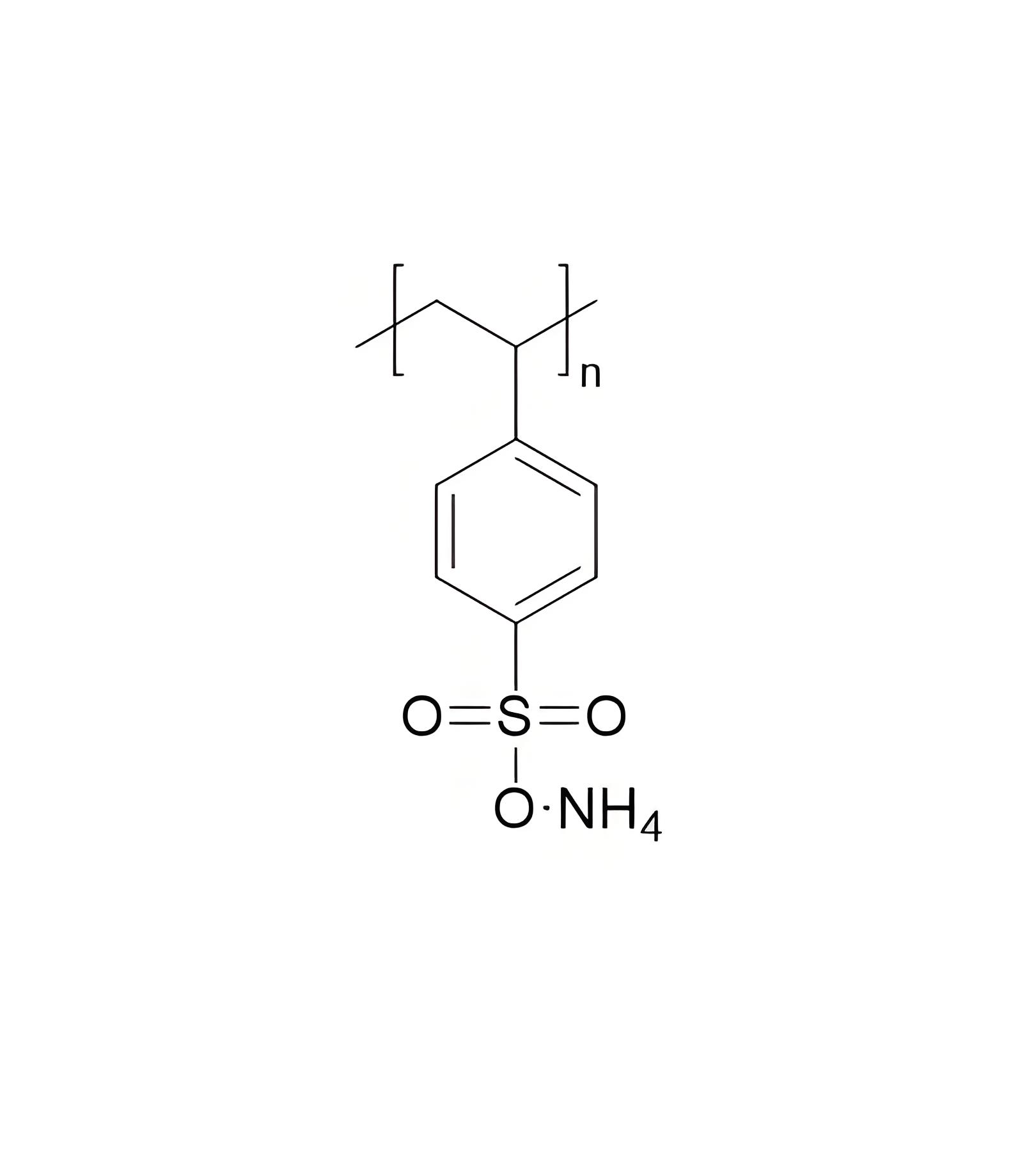
Poly(4-styrenesulfonic acid) ammonium salt solution (CAS No. 29965-34-2) is a water-soluble anionic polymer electrolyte. Its polymer backbone contains ammonium sulfonate groups, combining hydrophilic characteristics with the functional properties of a polymeric structure. This makes it a promising material for developing antistatic coatings, dispersion systems, and other functional polymer formulations.
Чанша Ютэн Новые Материалы, Лтд. operates its own manufacturing facility and has a dedicated R&D team. We offer products with customizable molecular weights, solid contents, and other specifications to support industrial formulation development and advanced material applications.
1. What Is Poly(4-styrenesulfonic Acid) Ammonium Salt Solution?
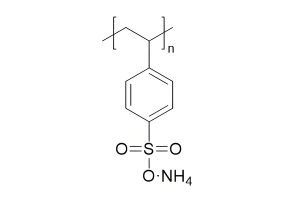
Poly(4-styrenesulfonic acid) ammonium salt is a polymer produced from ammonium 4-vinylbenzenesulfonate monomers and is commonly supplied as an aqueous solution.
Its molecular chains consist of repeating ammonium styrenesulfonate units, making it an anionic polyelectrolyte.
The material’s functional properties arise primarily from two structural characteristics.
Ammonium sulfonate groups: These highly hydrophilic ionic groups contribute to the polymer’s compatibility with aqueous systems and provide ionic functionality.
Polymer chain structure: The polymer backbone influences solution viscosity, film-forming behavior, and interactions with other formulation components, providing a foundation for dispersion control, coating applications, and rheological modification.
Unlike certain low-molecular-weight functional additives, the performance of polymeric polyelectrolytes depends not only on their chemical structure but also on molecular weight, molecular weight distribution, solids content, and formulation conditions.
Selecting the appropriate product specifications is therefore essential for achieving the desired processing and application performance.
2. Four Key Functional Properties
2.1 Antistatic Properties for Functional Surface Coatings
Electrostatic charge accumulation is a common concern during the processing of specialty paper, synthetic films, and certain electronic materials.
Poly(4-styrenesulfonic acid) ammonium salt contains ionic functional groups and can be considered as a functional ingredient in water-based antistatic coating formulations.
Under suitable formulation and environmental conditions, its ionic characteristics may facilitate surface charge dissipation and help reduce electrostatic buildup.
For paper, films, and similar substrates, antistatic performance should be evaluated alongside coating thickness, adhesion, moisture resistance, and surface resistivity.
2.2 Dispersion and Stabilization in Water-Based Formulations
In coatings, inks, and certain adhesive systems, pigments, fillers, and other particulate materials may agglomerate, affecting dispersion uniformity and formulation stability.
As an anionic polyelectrolyte, poly(4-styrenesulfonic acid) ammonium salt can interact with particle surfaces and other formulation components, contributing to the regulation of dispersion behavior.
Under appropriate conditions, it may help improve particle distribution and reduce agglomeration.
Actual performance depends on particle surface chemistry, formulation pH, ionic strength, and dosage. Application-specific formulation testing is recommended.
2.3 Ion Exchange and Adsorption for Functional Material Development
Sulfonate groups possess ion-interaction and ion-exchange characteristics, making this class of polymers relevant to the development of adsorption systems, ion-exchange materials, and functional membranes.
By combining the polymer with other materials or applying suitable immobilization and crosslinking techniques, researchers can explore its potential in ion-exchange systems, separation membranes, and water-treatment materials.
It is important to distinguish a water-soluble polymer solution from an insoluble ion-exchange resin.
For practical ion-exchange or water-treatment applications, additional considerations typically include polymer immobilization, water resistance, mechanical stability, and long-term operating performance.
2.4 Film Formation and Rheological Modification
The polymer chain structure of poly(4-styrenesulfonic acid) ammonium salt provides potential film-forming and rheology-modifying properties.
In suitable water-based formulations, the material can be investigated for its influence on coating formation, viscosity, and processing behavior.
Adjusting molecular weight, solids content, and the proportions of other formulation components allows developers to explore different coating and film-forming conditions.
Final film performance must be evaluated in relation to substrate properties, drying conditions, humidity, and overall formulation composition.
3. Major Applications: From Industrial Coatings to Advanced Materials Research
3.1 Specialty Paper and Synthetic Films
Electrostatic buildup during specialty paper and synthetic film manufacturing may interfere with material handling, winding, processing, and end-use performance.
Poly(4-styrenesulfonic acid) ammonium salt can be used in the development of water-based antistatic coating formulations, providing an option for surface functionalization of paper and film substrates.
Key evaluation parameters include surface resistivity, coating adhesion, moisture resistance, and compatibility with existing manufacturing processes.
3.2 Coatings, Adhesives, and Inks
Water-based coatings, adhesives, and inks require a balance of particle dispersion, formulation stability, and rheological performance.
This polymer can serve as a functional anionic additive in dispersion studies and formulation optimization.
Depending on the system, molecular weight, solids content, and addition level can be adjusted to investigate their effects on viscosity, particle distribution, and coating uniformity.
3.3 Electronic Materials and Electrostatic Discharge (ESD) Protection
Electrostatic control is important in many electronic material manufacturing and processing operations.
Due to its ionic polymer structure, poly(4-styrenesulfonic acid) ammonium salt can be explored as a component in antistatic coatings and related functional material formulations.
For electronics and semiconductor applications, specific requirements should be assessed, including surface resistivity, humidity sensitivity, ionic residues, and material cleanliness.
3.4 Water Treatment and Separation Materials
The sulfonate groups in this polymer provide a structural basis for research into ion exchange, adsorption, and separation materials.
In water-treatment and environmental material development, the polymer can be investigated in combination with other polymers, membrane materials, or supporting substrates.
Through appropriate material design, researchers may explore its role in ion-selective separation, functional membranes, and adsorption systems.
These applications generally require additional material processing and performance validation. The aqueous polymer solution should not be regarded as a ready-to-use ion-exchange resin or desalination membrane.
3.5 Biomedical and Functional Polymer Research
Anionic polyelectrolytes have attracted research interest in biomolecular interactions, polymer composites, and functional carrier systems.
Poly(4-styrenesulfonic acid) ammonium salt may be investigated as a candidate material for studying interactions with other functional components.
However, biomedical applications have specific requirements for purity, biocompatibility, residual substances, and safety. Dedicated performance and safety evaluations are necessary before considering the material for drug delivery or other biomedical uses.
3.6 Chemical and Advanced Materials R&D
Beyond these applications, poly(4-styrenesulfonic acid) ammonium salt can be used as a research material in polyelectrolyte complexes, functional coatings, membrane materials, and water-based formulation development.
For projects requiring specific molecular weights or solids contents, customized product specifications can support research into the relationship between polymer properties and processing performance.
4. How to Select the Right Product Specifications
Different applications place different demands on poly(4-styrenesulfonic acid) ammonium salt solution.
Industrial customers should consider several important parameters when selecting a suitable grade.
Molecular Weight and Molecular Weight Distribution
Molecular weight influences solution rheology, processing characteristics, and interactions with other formulation components. An appropriate grade should be selected according to the intended application and manufacturing process.
Solids Content
Solids content determines the concentration of active polymer in the solution and affects formulation dosage, storage, transportation, and handling requirements.
Solution Viscosity and Stability
For coating, mixing, and continuous manufacturing processes, solution viscosity, storage stability, and compatibility with other formulation ingredients are important considerations.
Impurity Control and Batch-to-Batch Consistency
In electronic materials and specialty chemical applications, residual monomers, inorganic ions, and other impurities may affect product performance.
Consistent product specifications and reliable batch quality can help reduce formulation adjustments and production validation efforts.
Therefore, selecting this type of polymer requires an evaluation of both its chemical characteristics and its performance under actual application conditions.
5. Changsha Yuteng New Materials: In-House Manufacturing and Customized Polymer Solutions
Чанша Ютэн Новые Материалы, Лтд. is a manufacturer of poly(4-styrenesulfonic acid) ammonium salt solution (CAS No. 29965-34-2).
With our own production facility and professional R&D team, we provide product supply and customized solutions for customers in China and international markets.
In-House Manufacturing and Consistent Product Quality
Our manufacturing capabilities enable us to manage key production processes and quality parameters, with particular attention to molecular weight, solids content, and product consistency.
From laboratory-scale evaluation samples to bulk industrial procurement, we can coordinate product specifications and supply arrangements according to customer requirements.
Dedicated R&D Team and Custom Specifications
Different applications in specialty paper, functional coatings, electronic materials, and water-based formulations require different polymer characteristics.
Our R&D team works with customers to discuss customized molecular weights, solids contents, and specific quality requirements.
By matching product specifications with application conditions, we support customers in raw material selection, formulation development, and process optimization.
Factory-Direct Supply for Global Customers
Supported by our manufacturing and R&D capabilities, we provide raw material supply, flexible packaging options, logistics coordination, and technical communication services.
Whether you require materials for new product development, small-scale testing, or large-volume industrial production, we can discuss a supply solution tailored to your needs.
Заключение
Poly(4-styrenesulfonic acid) ammonium salt solution combines water solubility, ionic functionality, and polymeric characteristics, offering potential value in antistatic coatings, dispersion systems, functional membranes, and advanced materials research.
For industrial customers, selecting the appropriate molecular weight, solids content, and product specifications is essential to achieving the desired material performance.
Looking for a reliable manufacturer of poly(4-styrenesulfonic acid) ammonium salt solution (CAS No. 29965-34-2)?
Связаться с Чанша Ютэн Новые Материалы, Лтд. to discuss product specifications, customized solutions, evaluation samples, and bulk purchasing options.